
The “Proof of Citizenship” Trap: An Explainer
Explainers: Democracy Elections Legislation Presidential Elections State/Local Elections Voter Suppression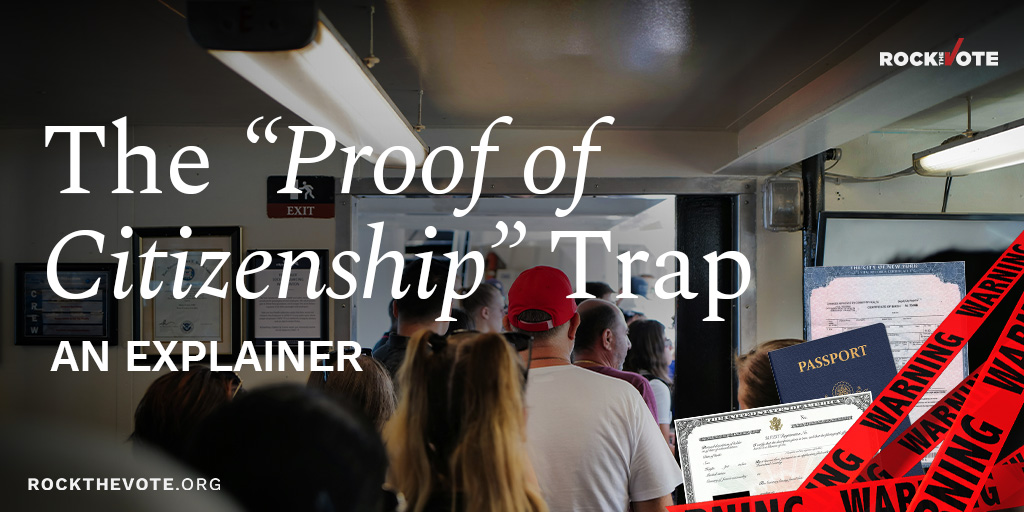
What is the “Proof of Citizenship” Trap?
The Proof of Citizenship Trap refers to policies that require documentation that proves citizenship to register or to vote. On its surface, these policies seem reasonable, but they are both unneeded and have devastating consequences for millions of eligible voters across the country.
Why are “proof of citizenship” laws a trap?
When these policies are in place, registering to vote or updating your registration goes from a quick, simple task to an otherwise unnecessary, time-consuming trip to your local election office or DMV — and that’s just for voters who have all the necessary hard copy documents readily available. For those who do not have their documents readily accessible, registering to vote can become a multi-step, expensive, and lengthy process.
If you cannot provide the right documents, you cannot register or vote. Supporters of these bills claim that it will reduce noncitizen voting; however, noncitizen voting is already illegal and extremely rare.
The phrase “proof of citizenship” is an example of political marketing designed to sound neutral, familiar, and common sense, but carries significant implications and ulterior motives. The wording “proof of citizenship” is specifically framed to limit inquiry and dissent as it automatically makes someone who questions it seem unreasonable, unpatriotic, or in favor of lawlessness.
Is noncitizen voting a regular problem?
No, noncitizen voting is not a widespread or common issue. It is already illegal for anyone who is not a citizen to register or to vote — every eligible U.S. voter must already verify their citizenship status when registering to vote.
There are already successful procedures in place for authorities to identify these rare instances, find the offender, and prosecute them. The practices currently in place are proven to be effective and do not harm or suppress eligible voters.
An analysis of The Heritage Foundation’s election fraud database conducted by the Bipartisan Policy Institute, found only 77 instances of noncitizens casting a ballot between 1999 and 2023. In other words, on average, only 3 votes per year were cast by noncitizens. Cases of noncitizens voting are incredibly rare and are successfully detected and prosecuted when they occur.
Why is noncitizen voting so rare?
The penalties for noncitizen voting are severe. Illegal voting activity is investigated and prosecuted by the U.S. Department of Justice as well as by state and local authorities. Noncitizens caught voting can face jail time, deportation, and lose any chance of becoming a U.S. citizen in the future. There’s no incentive.
How is this different from voter ID laws?
Citizenship documentation laws go beyond voter ID laws, which typically require a photo ID to confirm a voter’s identity. While not all states require a photo ID to vote, those that do may accept a driver’s license, military ID, tribal ID, or even a school ID. Photo ID laws vary state by state.
Proof of Citizenship or show-your-paper laws, require individuals to present original hardcopy documents that verify citizenship status. Examples of these documents include a birth certificate, passport (which cost $130), or naturalization certificate. In most cases, electronic or paper copies of documents are not acceptable — and the name on the document must match the name of the voter.
Most forms of ID currently used by Americans to vote (including REAL-ID-compliant driver’s licenses) do not show citizenship status.
Only five states currently offer an Enhanced Driver’s License (EDL) that includes citizenship status. EDLs are only available upon request from residents of states that share a border with Canada: Michigan, Minnesota, New York, Vermont, and Washington. EDLs are not the same as a standard issued driver’s license — residents must be aware of and request the EDL option.
In short, millions of eligible voters would need to acquire or dig up extra documents just to register to vote or update their voter registration. These policies place the administrative burden on voters, instead of having clerks verify a voter’s eligibility through already existing methods that have proven to be successful.
Again, supporters of these policies claim that they will reduce noncitizen voting; however, noncitizen voting is already illegal, extremely rare, and prosecuted in the very few cases in which it occurs. The reality is that these laws will make it harder for already eligible voters to cast their ballots.
Who gets hurt by proof of citizenship laws?
Everyone. A democracy, by definition, requires participation by all its citizens. A healthy democracy encourages and supports voters, rather than making participation harder by setting up bureaucratic hurdles — especially when states already have processes to verify voters’ citizenship status.
More than 21 million U.S. citizens of voting age do not have ready access to citizenship documents. For context, the difference between the number of votes cast for the two major candidates in the 2024 Presidential Election was 2.3 million. A total of 153 million people voted in 2024, meaning 21 million is a substantial number of voters.
By negatively affecting a large percentage of voters who are otherwise eligible to vote, documentation-of-citizenship laws make our elections less democratic, and are therefore less reflective of the will of the people. Proof of citizenship laws hurt our democracy. Period.
For those who do not have ready access to documents proving citizenship, they will need to apply for these documents – often at a cost. To get a new or renewed passport, it can cost more than $100 and, depending on the state, it can cost around $10-30 to get a replacement birth certificate. These fees don’t include the travel cost, potential care costs (child, elderly, or people with disabilities), or the time needed away from work, school, or other responsibilities.
Those without ready access to required citizenship documents are more likely to be:
- Young Adults: Many young adults have had limited exposure to their birth certificate and do not know its exact location. College students are unlikely to have their original birth certificate, or even a copy, at school.
- Elderly People: It’s not unusual for elderly individuals to lack documentation. They may have been born before birth certificates were common or they may have been born at home at a time when birth certificates were not required. They also may have lost documents as they aged, moved, or as a result of needing them less frequently.
- Married Women: Approximately 84% of married women change their last name as well as some men. Consequently, 69 million women and 4 million men do not have a birth certificate that matches their name.
- Rural Residents: Government offices are scarce in rural areas, requiring residents to travel longer distances to obtain the necessary documents. Rural residents are also less likely to have a passport.
- Naturalized Citizens: While native-born citizens can obtain a new copy of a birth certificate from a local or state government office, naturalized citizens must go through a longer, more complex, and more expensive process through a federal government office to replace their Certificate of Naturalization. A replacement costs over $500.
- Low-Income Individuals: Individuals from low-income backgrounds or experiencing economic hardships are more likely to lose important documents when moving, are less likely to have a passport, and can’t afford the cost of travel and fees associated with replacing their documents.
Are there real life examples of these laws suppressing voters?
Yes. In 2024, New Hampshire passed a law requiring documentation of citizenship to register to vote. When local elections were held the following year, longtime residents were turned away. Some took multiple trips to provide the required documents. One woman, for example, had to make three trips to her polling location before she was able to vote:
- She was first told her photo ID wasn’t acceptable and that she needed her birth certificate or passport.
- She returned with her birth certificate and was told that she needed another official document because it did not match her married name on her photo ID.
- She returned to her polling location a third time with her marriage license and birth certificate and was finally able to cast a ballot.
New Hampshire accepted a marriage certificate as proof of a name change; however, not all proof of citizenship policies would. While the woman in this example was ultimately able to vote, the multiple trips cost her unnecessary time and money.
Others faced with similar issues were unable to vote because they had to go to work and could not afford the time for multiple trips, or they could not produce the required documentation in time. This is how laws requiring documentation of citizenship can lead to voter suppression.
What’s happening at the federal level?
The “SAVE” Act was introduced into Congress for the first time in 2024 and reintroduced in 2025.
If passed, the bill would require all voters to appear in-person to register or update their registration as well as provide a hardcopy, original document of citizenship such as a passport or a birth certificate. Government-issued driver’s licenses — including REAL IDs as they exist now — as well as military or tribal IDs alone would no longer satisfy voter registration requirements. This new bureaucratic hurdle would be a required step every time a voter registers to vote, including when they change their name, address or party affiliation.
In March 2025, President Trump signed an executive order that included mandating documentation of citizenship for voter registration. Shortly after it was signed, a federal court blocked the order from taking effect, citing concerns over legality and voter access.
Bills requiring documentation of citizenship — like the “SAVE” Act — are being introduced at the state and federal levels, causing this to be an ongoing issue.
Why should I care?
If these administrative roadblocks become law, you or someone you know could lose the ability to vote, even if you are a U.S. citizen. This is not just about paperwork. It’s about how accessible (or inaccessible) our democracy is to its own citizens. And while it’s important to have secure elections, these laws don’t address a real problem, they just create new ones for millions of eligible Americans.
What can I do?
- Check your voter registration or register to vote to make sure everything is current
- Contact your federal and state elected officials and tell them you oppose barriers to voting, like proof of citizenship laws
- Learn even more about the SAVE Act and proof of citizenship laws.
Published October 17, 2025.