
January 6th: An Explainer
Explainers: Constitution Democracy Elections History Presidential Elections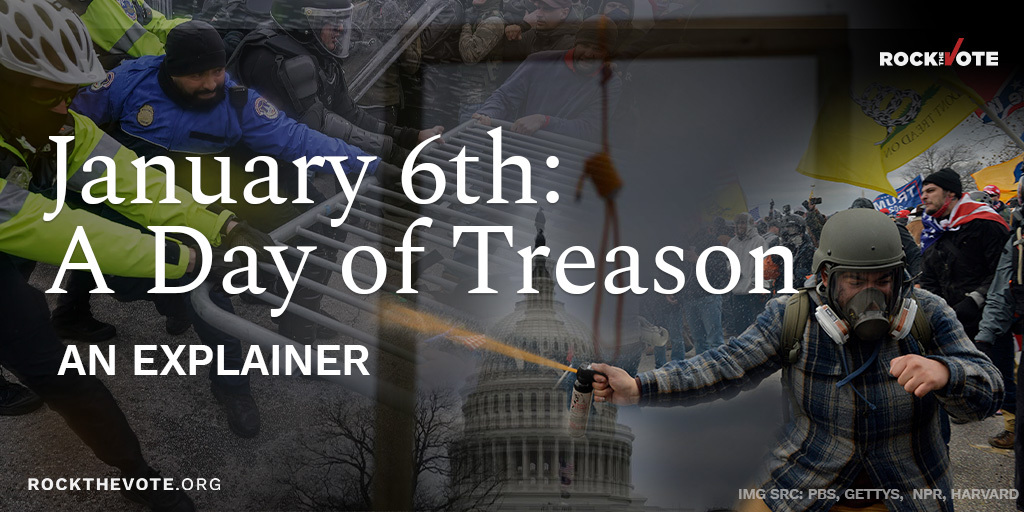
Why is January 6th an important date?
Following a Presidential Election, federal law requires the U.S. House of Representatives and the U.S. Senate to hold a joint session to verify and count the electoral votes. The aim of the process is to certify the election and officially determine the next president.
Law requires this joint session occur at 1:00 PM ET on January 6th after every Presidential Election.
On January 6th, 2021, an insurrection occurred that sought to stop the certification of the 2020 Election.
What happened on January 6th, 2021?
As Congress met to count electoral votes and certify the outcome of the 2020 Presidential Election, an estimated 2,000 to 2,500 individuals forced their way past security barricades and attacked the U.S. Capitol.
They took down the U.S. flag and flew the confederate battle flag — an enemy flag of the United States. They assaulted Capitol Police, smashed windows, and broke down doors, causing nearly $3 million worth of physical damage.
They shouted “where are you Nancy [Pelosi]?” and chanted “hang Mike Pence!” as they searched for members of Congress and ransacked offices. Congresspeople and staff members were forced to evacuate, seek emergency refuge, hide under furniture, or barricade in their offices.
The attack on January 6th meets key definitions of treason and insurrection. By storming the Capitol, rioters sought to overthrow the constitutional order, a betrayal to the United States and our democratic system.
Their attack injured more than 140 law enforcement officers and resulted in at least seven deaths. The psychological impact on the thousands of affected individuals and officers was significant, with many reporting PTSD and long-term trauma.
The full cost of the attack is estimated at $2.7 billion. It marked the first time in U.S. history that the peaceful transition of power was violently disrupted.
Why did these individuals storm the U.S. Capitol?
Despite clear and definitive election results, then-President Donald Trump falsely claimed that the 2020 presidential election had been stolen from him. He created and repeatedly promoted baseless, false claims of widespread election fraud that were investigated and rejected by courts, election officials from both parties, election recount results, and his own administration officials. No evidence supporting his claims was ever found.
The individuals who stormed the Capitol believed Trump’s false claims.
Before the 2020 election even took place, President Trump began falsely claiming that mail-in voting would lead to fraud and that the election could be “rigged” against him. After losing the November 2020 election decisively to Joe Biden, Trump intensified these unfounded conspiracy theories. Several Republican officials and prominent media outlets amplified these false claims.
President Trump organized a ‘Stop the Steal’ rally (also called the ‘Save America Rally’) on January 6th to oppose the certification of the election results. At the rally, Trump told the crowd to “fight like hell” and directed them to march to the Capitol. Motivated by Trump’s false claims that the election had been stolen, thousands marched from the rally to the Capitol building, where they attacked law enforcement and forced their way inside in an attempt to stop Congress from certifying Joe Biden’s victory.
How did law enforcement prepare for the events of January 6th?
Local and federal law enforcement organized security for the Congressional Joint Session and the rallies planned throughout the District of Columbia for that day.
Multiple rallies were scheduled across Washington, D.C. on January 6th, making security coordination complex. Rally organizers filed permits for several events, including the main “Stop the Steal” rally at the Ellipse (where Trump spoke), rallies at Freedom Plaza and the Sylvan Theater near the Washington Monument, and smaller events near the Capitol. The permit for the Ellipse rally was initially filed for 5,000 attendees but was amended just days before the event to 30,000. Capitol Police suspected that some permit applications were proxies for “Stop the Steal” organizers attempting to position supporters closer to the Capitol.
Rally organizers deliberately misled law enforcement — repeatedly telling the National Park Service they had no plans to march to the Capitol despite internal communications showing they knew Trump would call for a march. Law enforcement agencies developed their own intelligence estimates before January 6th, but these estimates varied widely — ranging from as low as 2,000 to as many as 80,000 people across all events, according to Army Secretary Ryan McCarthy’s testimony. This wide variation in predictions, combined with organizers’ deception, contributed to coordination challenges.
The actual attendance far exceeded most estimates: the House January 6th Committee estimated approximately 53,000 people attended Trump’s speech at the Ellipse, while classified Secret Service data later revealed that as many as 120,000 people gathered across the National Mall area that day.
The local DC Metro Police Department (MPD) coordinated with the federal agents of the U.S. Capitol Police (USCP), U.S. Park Police (USPP), and the U.S. Secret Service to cover the protests.
As typical preparation for large planned demonstrations in D.C., USPP called in additional officers from New York. DC Mayor Muriel Bowser requested that the D.C. National Guard support with a minimal presence.
According to a Government Accountability Office report, approximately 81 percent of Capitol Police officers — about 1,482 officers — were on duty at the Capitol complex at some point that day. They were supported by 1,000 MPD officers in the area. Additionally, 50 Homeland Security officers working in an Federal Protective Service capacity stood by in the Ronald Reagan Building just over a mile from the Capitol Building. USPP SWAT members were also stationed near the Capitol and the White House.
How did law enforcement respond to the events of January 6th?
Despite the presence of multiple law enforcement agencies, the protests escalated into riots that breached the U.S. Capitol. Security and law enforcement officers, largely avoiding the use of their weapons, were overwhelmed and forced to retreat.
The moment rioters breached the Capitol, U.S. Secret Service Headquarters issued an emergency alert calling all available agents to help secure the building. A similar alert was sent over the police mutual aid radio system used by all federal, state, and municipal law enforcement agencies in the Washington, D.C. region.
However, the response was fragmented. U.S. Park Police could only send a few officers because most were responding to a related attack on the Washington Monument. Agents from the FBI and Bureau of Alcohol, Tobacco, and Firearms responded with reinforcements. National Guard units from neighboring states, including Virginia (3:29 PM), Maryland (3:47 PM), and New Jersey (4:57 PM) were also deployed.
By 5:45 PM, nearly four hours after the breach began, officers finally established a security perimeter around the Capitol.
What went wrong?
The attack didn’t come as a surprise to intelligence agencies — warnings were ignored. As early as December 2020, the FBI received specific tips about plans for violence on January 6th, including warnings that extremist groups intended to “literally kill people” and that Trump supporters believed they had “orders from the President” to attack the Capitol.
Despite these warnings, federal agencies failed to act. According to a Senate report, the FBI and Department of Homeland Security downplayed or ignored “a massive amount of intelligence information” before January 6th. The FBI produced only two limited intelligence reports about the attack — both issued the night before. On the morning of January 6th, even as armed protesters wearing tactical gear gathered at the Capitol, the FBI briefed that there were “no credible threats.”
This intelligence failure left law enforcement agencies unprepared for the scale and violence of the attack.
What was unique about law enforcement’s response?
The delayed response of the D.C. National Guard highlights a unique vulnerability in Washington, D.C.’s security structure.
Unlike state governors who can quickly mobilize National Guard units, Washington, D.C. is a federal territory and cannot mobilize its own National Guard without federal approval. Normally, the commander of the D.C. National Guard has authority to respond to rapidly developing dangerous situations, but the Pentagon removed that authority in the days leading up to January 6th, 2021.
Questions remain about the reason and timing of this protocol change and whether it was clearly communicated to other law enforcement agencies.
As the attack unfolded, Capitol Police Chief Steven Sund filed a formal request for D.C. National Guard support at 1:49 PM — after rioters had already breached the Capitol. The request sat pending with the Secretary of Defense’s office. President Trump could have expedited the bureaucratic process but initially refused to authorize the D.C. National Guard to secure the building and protect those trapped inside.
Members of the D.C. National Guard finally arrived at the Capitol nearly four hours later at 5:30 PM, despite dozens of soldiers having been on standby to serve as a quick response force.
Were the attacks limited to Washington, DC?
No. On January 6th, 2021, “Stop the Steal” protests took place at state capitols across the country. While the violence at the U.S. Capitol in Washington, D.C. was the most severe, demonstrations occurred at state government buildings nationwide.
Protests were reported in states including Arizona, Oregon, California, Michigan, Pennsylvania, Georgia, Kansas, Wyoming, and Texas. Some state capitols took precautionary measures such as closures and evacuations in response to the events unfolding in Washington, D.C.
In several states, protests turned confrontational. In California, eleven people were arrested for illegal weapons possession near the state capitol in Sacramento and at least one assault was reported. In Arizona, protesters pounded on state capitol doors and broke a window. A demonstration in Salem, Oregon turned violent that same day. In Michigan, several hundred protesters wielded guns and carried “Stop the Steal” signs outside the state capitol, though they did not storm the building. In Washington state, the governor and his family were moved to a secure location as a precaution.
Though none of the state-level events matched the scale of violence in Washington, D.C., the armed protests, physical confrontations, and forced security evacuations at state capitols across the country demonstrated a coordinated effort to use intimidation and force to challenge the 2020 election results.
What was the January 6th Committee?
In the months before January 6th, 2021, federal law enforcement agencies were already warning about rising threats. In August 2020, the FBI published a report warning that extremists with strong political views might commit acts of violence around the time of the 2020 election. After the attack on the Capitol, the Department of Homeland Security issued an alert saying:
After the attack, Congress tried to create an independent, bipartisan commission to investigate what happened — similar to the commission that investigated the 9/11 terrorist attacks.
In May 2021, the House passed a bill to create this commission with support from 35 Republicans, but Senate Republicans blocked it.
When the independent commission failed, the House created the Select Committee to Investigate the January 6th Attack on the United States Capitol on June 30th, 2021. The vote was 222-190, with only two Republicans — Representatives Liz Cheney of Wyoming and Adam Kinzinger of Illinois — voting yes.
The nine-member Committee included seven Democrats, with Representative Bennie Thompson (D-MS) as chair, and two Republicans — Liz Cheney (R-WY), who served as vice chair, and Adam Kinzinger (R-IL). After Speaker Pelosi rejected two of Minority Leader McCarthy’s choices for conflicts of interest, he withdrew all his nominees, leading Pelosi to appoint Cheney and Kinzinger. Cheney and Kinzinger faced serious backlash from their own party for joining the committee.
Many Republican officials who initially condemned the attack changed their position as Trump downplayed it. For example, on January 12th, 2021, Minority Leader Kevin McCarthy publicly called on President Trump to “accept his share of responsibility” stating “the President bears responsibility for Wednesday’s attack on Congress by mob rioters”. In private audio recordings with fellow Republican officials, McCarthy stated he thought the President should resign. Shortly after making these statements, McCarthy visited Trump at Mar-a-Lago and completely reversed course, never publicly criticizing Trump’s role in January 6th again and opposing the creation of an independent January 6th commission.
Cheney and Kinzinger repeatedly asked their Republican colleagues to be honest about what happened on January 6th, even though it may hurt them politically. In February 2022, the Republican National Committee officially condemned both of them — something the RNC had never done before to sitting Republican members of Congress. Kinzinger decided not to run for reelection, and Cheney lost her primary election in August 2022 after refusing to “lie about the election.”
The Committee’s job was to investigate the facts and causes of the January 6th attack, including:
- What led to the violence
- How law enforcement prepared and responded
- The role of extremist groups
- Efforts to overturn the election results
- Ways to prevent future attacks
What evidence did the Committee uncover?
Over 18 months, the Committee interviewed more than 1,000 witnesses, reviewed hundreds of thousands of documents, and held 10 public televised hearings. The vast majority of witnesses were Republicans, including Trump administration officials, White House staff, campaign workers, and his own family members.
About Efforts to Overturn the Election
The Committee found evidence of a coordinated plan to overturn the 2020 election results. This included:
- Spreading false claims about election fraud even after being told by his own Attorney General and campaign officials that there was no evidence
- Pressuring state officials to “find” votes or change election results
- Creating fake slates of electors in seven states to replace the legitimate ones who had been certified by those states
- The President pressuring Vice President Mike Pence to reject electoral votes, despite being told it was illegal
- Organizing the January 6th rally and directing supporters to march to the Capitol
In key testimony, Former Attorney General William Barr testified that he told Trump the election fraud claims were “bullshit” and had no basis in fact.
About What Happened During the Attack
The Committee uncovered new details about the 187 minutes between when Trump finished his speech and when he finally told rioters to go home:
- Trump knew his supporters were armed but demanded security screenings be removed, saying “they’re not here to hurt me”
- He watched the attack unfold on TV but refused to call it off for hours
- He ignored desperate pleas from family members, Fox News hosts, and members of Congress begging him to intervene
- He made no calls to law enforcement, the National Guard, or Cabinet members to stop the violence
- After more than 3 hours, instead of condemning the violence, he posted a video telling rioters “we love you, you’re very special”
In key testimony, White House aide Cassidy Hutchinson testified about what she witnessed in the White House, including Trump’s anger when told he couldn’t go to the Capitol and warnings about potential violence that were ignored. Additionally, Capitol Police Officer Harry Dunn and DC Metropolitan Police Officer Michael Fanone described the brutal violence they faced while defending the Capitol and members of Congress.
About Extremist Groups and Violence
Warnings were ignored. The attack didn’t come out of nowhere. As early as December 2020, the FBI received specific warnings about plans for violence on January 6th, including:
- Reports that Trump supporters were discussing online how to sneak guns into the city to “overrun” police
- Over 1 million social media mentions of storming the Capitol in the weeks before January 6th
Despite these warnings, federal agencies under Trump’s administration failed to take them seriously.
Extremist groups led the attack. Evidence showed that extremist groups like the Oath Keepers and Proud Boys played a central role in planning and executing the attack. The evidence was strong enough that federal prosecutors successfully convicted members of seditious conspiracy — plotting to use force to prevent the peaceful transfer of power.
The Committee also documented:
- Communications between rally organizers and extremist groups before January 6th
- How online misinformation and conspiracy theories fueled the violence
- Connections between some extremists and people in Trump’s circle
Additional Resources on the Committee’s Work
Were those who attacked the Capital held legally accountable?
More than 1,500 people from nearly all 50 states were charged in connection with January 6th, ranging from those who simply entered the Capitol to those who violently assaulted police officers. The attack caused an estimated $2.7 billion in costs to taxpayers, including damage to the Capitol building and grounds, deployment of additional law enforcement, and security improvements. Hundreds were convicted and sentenced to prison, including leaders of extremist groups like the Oath Keepers and Proud Boys who were found guilty of seditious conspiracy.
However, after winning the 2024 presidential election, Donald Trump pardoned nearly all of those convicted upon taking office in January 2025. He has called the rioters “patriots” and claimed they were “assaulted by our government” — despite the fact that approximately 140 police officers were injured during the attack. The pardons mean that most people responsible for the violence and destruction at the Capitol have faced little to no lasting consequences.
Was President Trump held legally accountable?
In 2022, Attorney General Merrick Garland appointed Special Counsel Jack Smith to investigate Trump’s role in attempting to overturn the 2020 election and the events of January 6th.
In his final report published just days before Trump was sworn in for his second term, Smith concluded that Trump engaged in “unprecedented efforts to unlawfully retain power after losing the 2020 election.” Based on the Justice Department’s policy against prosecuting sitting presidents, the criminal case against Trump was dropped.
In a December 2025 deposition before Congress, Smith said his team had developed “proof beyond a reasonable doubt” that Trump engaged in a “criminal scheme” and stated that the January 6th attack “does not happen without him.”
How has evidence of what occurred on January 6th been preserved for the historical record?
After Trump returned to office in January 2025, video evidence and court documents from January 6th cases began disappearing from government platforms. A federal judge ordered the administration to halt the removal after news organizations discovered evidence — including videos of rioters assaulting police — had been taken down. Trump has also pressured media outlets over their January 6th coverage.
News organizations like NPR have created archives to preserve this evidence, though even these independent sources face pressure. As government resources continue to be removed, some links and sources in educational materials like this may no longer work or provide complete information.
How have the events of January 6th divided our nation?
January 6th remains one of the most polarizing events in recent American history. According to polling from early 2024, 55% of Americans viewed it as “an attack on democracy that should never be forgotten” — but views split sharply along partisan lines. Only 18% of Republicans in one poll viewed the attack as violent, compared to the overwhelming majority of Democrats. Some Republican officials have downplayed the attack, with Rep. Andrew Clyde (R-GA) even characterizing it as a “normal tourist visit” despite extensive video evidence of violence and destruction.
Trump and his allies have worked to reshape the narrative around January 6th, dismissing the violence and focusing instead on claims of unfair prosecution. This effort to rewrite what happened has made January 6th not just a historical event, but an ongoing political battle over truth and accountability.
Why does understanding the events of January 6th matter?
January 6th, 2021, exposed a critical truth: democracy is not self-sustaining. It requires active participation and vigilance from everyday citizens. The attack succeeded in part because false claims about election fraud went unchallenged by enough people, and because many Americans felt disconnected from the democratic process.
Understanding what happened on January 6th is essential for ensuring history doesn’t repeat itself — and your participation matters.
Why is the peaceful transfer of power so important?
The peaceful transition of power is one of America’s oldest democratic traditions. It represents the orderly handoff of authority from one administration to the next, ensuring stability even when elections are contentious.
January 6th marked the first time in U.S. history that this peaceful transition was violently disrupted. The attack targeted the Electoral College certification — the constitutionally mandated process where Congress officially counts electoral votes and certifies election results.
This wasn’t just an attack on a building or a ceremony. It was an attack on the fundamental process that makes your vote count.
How can you help protect democracy?
January 6th serves as a call to action for every American:
- Vote in every election: Local, state, and federal elections all matter. Many of the officials who certified the 2020 election results despite enormous pressure were state and local election officials. Your vote determines who holds these positions.
- Hold leaders accountable: Pay attention to how elected officials respond to attacks on democracy. Contact your representatives and let them know you expect them to uphold democratic norms and the rule of law.
- Resist disinformation: False claims about election fraud fueled the January 6th attack. Learn how to identify and combat misinformation about elections and voting.
- Understand the electoral process: The more you understand how elections work — from voter registration to certification — the harder it is for bad actors to exploit confusion and spread false information.
Upholding democracy isn’t just the responsibility of government institutions. It’s the responsibility of every citizen committed to preserving the principles of equality, justice, and freedom. January 6th showed us what happens when we take democracy for granted. It’s up to all of us to ensure it never happens again.
Published January 5, 2026.