
The State of the Union: An Explainer
Explainers: Constitution Democracy Government History Office of the President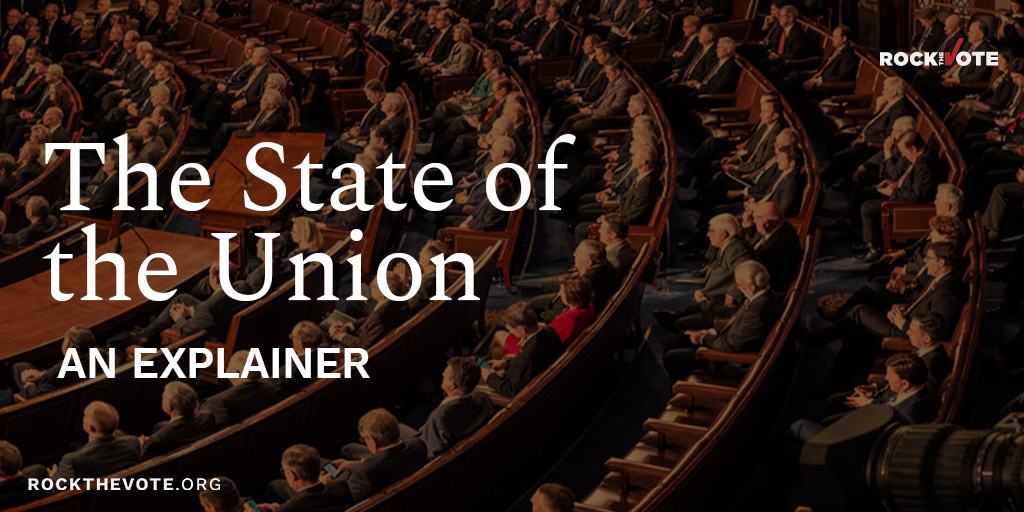
What is the State of the Union?
The State of the Union (SOTU) is a speech delivered by the President to Congress, usually given every year between January and February. It serves as a report on the nation’s current state and as a preview of the President’s priorities and goals for the upcoming year.
While the SOTU is not required by the Constitution, an update on the state of the union by the President to Congress is required, though the Constitution does not mandate where or how this briefing takes place:
“[The President] shall from time to time give to the Congress Information of the State of the Union, and recommend to their Consideration such Measures as he shall judge necessary and expedient” (Article II, Section 3).
A President may give a major speech to Congress and opt not to make it an official State of the Union address. This is not uncommon for the beginning of a President’s first term.
There have been 100 in-person State of the Union Addresses between 1790 and 2024. There are other instances where Presidents wrote their State of the Union addresses, or had them read in Congress.
Why is the State of the Union important?
Among the three-branches of the government, Congress most closely represents the American people as its members – Representatives and Senators – represent a district or a state. Prior to radio and television, a speech to Congress was the closest the President could get to speaking to the entire nation.
The State of the Union is an opportunity for the President to speak directly to the country. It allows the President to address pressing issues facing the country, laying out their administration’s agenda for the next year.
The address typically covers a wide range of topics like the economy, national security, democracy, and international policy, and serves as a moment for the President to both reflect on the past and provide a vision for the future.
What happens after the State of the Union?
After the State of the Union, the opposing political party delivers an opposition response. This tradition began in 1966 when Senator Everett Dirksen and Representative Gerald Ford gave a televised rebuttal to President Lyndon Johnson’s address. Since then, the response has been a regular feature, aired shortly after the President’s speech.
It’s also common for American citizens, aka voters, to contact their Representatives and Senators after the State of the Union to express their views on the challenges, priorities, and solutions raised in the address.
Where is the State of the Union held?
Since 1800, the SOTU has typically been held in the House of Representative Chamber in the U.S. Capitol Building during a joint session of the Senate and the House. The House is often referred to as “The People’s House”.
A presidential motorcade transports the President from the White House to the U.S. Capitol for the annual State of the Union Address. The exact route the motorcade takes is planned by the Secret Service in coordination with local law enforcement. Upon arrival at the Capitol, the President is escorted into the House chamber by the Speaker and the Vice President.
This process can best be understood as going into your boss’s office to give an annual performance review. Rather than making an announcement from the Oval Office, the president presents themselves in front of Congress and the American people who serve as the ultimate “boss” of the administration.
What’s the process for deciding if there will be a State of the Union and when it will take place?
Both chambers – the House and the Senate – must each pass a resolution setting a date and time for a joint session. The Speaker of the House formally invites the President, typically several weeks before the scheduled date.
It’s as if a boss is asking an employee for a status report. Congress represents the American people, and we, the people, are the ultimate boss in our democracy. The President is supposed to describe the country’s status, make recommendations, and outline priorities, just like an employee would when asked for a progress report.
What is the history of the State of the Union?
Before 1934, the annual address was delivered in December. The ratification of the 20th Amendment in 1933 moved the start of congressional sessions to January, shifting the address to the start of the year.
The State of the Union has evolved in length, frequency, and delivery method.
- 1790: President George Washington delivered the first address. At the time, it was called “The Annual Message.”
- 1923: President Calvin Coolidge’s address was the first to be broadcast on the radio.
- 1935: President Franklin Roosevelt first used the title “State of the Union,” but it did not become official until 1947.
- 1947: President Harry Truman’s address was the first to be televised.
- 2002: President George W. Bush’s address was the first to be live-streamed on the White House website, expanding its accessibility to a global audience.
How have advancements in technology shaped the State of the Union?
As technology has advanced, the State of the Union Address has evolved from an administrative report to Congress to a live, prime-time broadcast that directly addresses the American people. Millions of Americans are able to watch the president’s speech in real-time to learn about their legislative agenda for the coming year, and to watch the response of the opposition party that is delivered after the end of the State of the Union.
Because the event is now televised live, the State of the Union Address has also become a venue for political symbolism and visual protest. Attendees may use pins, buttons, or even their clothing to show support for a cause or protest against particular policies. For example, in the past, groups of women have worn white to show their support for reproductive rights and to honor the suffragists who fought for the passage of the 19th Amendment.
Cameras can also capture the smallest of gestures, like nods or facial expressions. For example, during Biden’s 2024 State of the Union, Republican Senator James Lankford appeared to ‘nod in agreement’ about the facts of the bipartisan immigration bill while others in his party booed. Having worked on the bipartisan bill, Lankford was censured by the Oklahoma Republican Party prior to the State of the Union and received further backlash following his visible support.
What does the phrase “pomp and circumstance” mean in relation to the State of the Union Address?
The term “pomp and circumstance” refers to a criticism that the State of the Union address has become more theatrical and partisan over time, rather than constructive.
The address itself is an important constitutional tradition. The president is meant to report to the American people, and the gathering of members of Congress, Supreme Court justices, and military leaders reflects the seriousness of that responsibility.
But as it has evolved from a written report into a televised, prime-time event with high-profile guests, it has also turned into more of a spectacle. Dramatic announcements, exchanges with hecklers, and pointed reactions have, at times, pulled focus from the actual report to the theatrics surrounding it. Questions about decorum, including how disrupted behaviors are handled and whether rules are applied evenly, contribute to this perception.
Who is invited to the State of the Union Address?
Invitees and attendees of the State of the Union include members of the House and Senate, the Vice President, the President’s Cabinet, Justices of the Supreme Court, military leaders, the diplomatic corps (foreign diplomats living in America), and former members of Congress.
The President is allowed up to 24 guests who sit with the President’s spouse in the President’s Box. These guests may be referred to during the address in an attempt to humanize a policy or issue facing the American people.
Members of Congress are allowed up to one guest. They often choose someone in their district they wish to honor. The Speaker of the House is allowed up to 24 guests for the box reserved for the Speaker’s Box.
The Press Box includes the Capitol Hill Press Corp, journalists, and reporters who cover Capitol Hill.
Who sits where at the State of the Union Address?
With the exception of specific leadership roles, seats in the chamber are not assigned as they are during normal Congressional sessions. Instead, members sit on a first-come, first-served basis, though House Representatives and Senators often group together by political party.
The Speaker and the Vice President sit on the dais, a raised platform behind the President. The dais provides a visible presence of both the executive and legislative branches of government, symbolizing unity and their joint role in serving the nation.
Seats in the well, the area at the front of the chamber, are reserved for the President’s Cabinet, Justices of the Supreme Court, the Joint Chiefs of Staff, former Members of Congress, and members of the diplomatic corps.
During the State of the Union address, the gallery is filled with invited guests, including special guests of the President and First Lady and members of the public invited by members of Congress.
The press is seated in the House Press Gallery, a designated area for journalists covering the event.
Who notably does not attend the State of the Union?
Customarily, there is one member of the President’s Cabinet, known as “the cabinet member not in attendance,” who does not attend the State of the Union. The designated survivor is a commonly known term for the individual; however, the White House has never used that term.
The selected cabinet member watches the address at an offsite secure undisclosed location. This precaution ensures that our government will continue to have a leader in the case of an emergency that results in the death of the President, Vice President, and others in the presidential line of succession.
The practice of one non-attending cabinet member dates back to at least the 1960s, but may have been earlier. The White House was not public about the practice and the name of the individual cabinet member until the 1980s.
Individuals learn they are to be the designated survivor a few weeks before, which they are required to keep secret. They undergo special training sometime prior to being taken away by secret service agents ahead of the State of the Union address.
How can I prepare for the next State of the Union?
Tune in to stay informed on the President’s priorities and proposals for the year ahead. You could even make it an event and invite friends over to watch together. Afterwards, consider contacting your elected officials to share your thoughts.
Published February 28, 2025. Updated February 13, 2026.